




VW Brake Wear in Stop-and-Go Traffic: What to Watch For
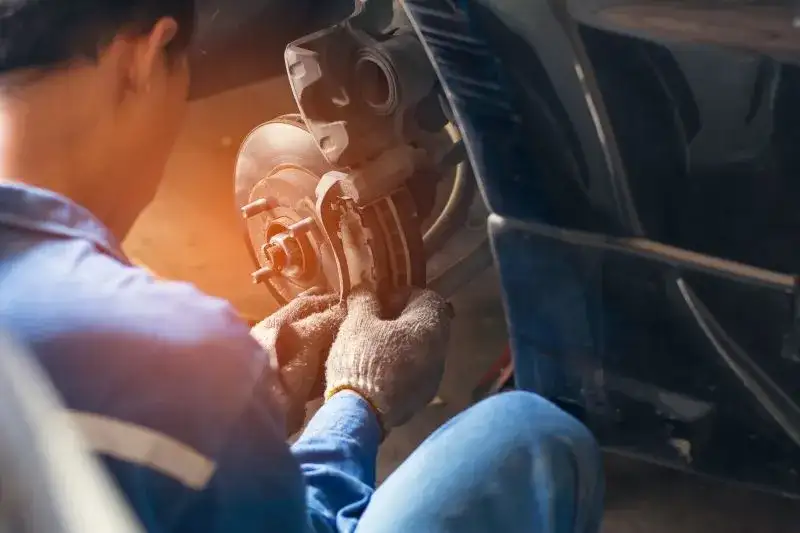
Last month, a Volkswagen Tiguan came in from Colton after its owner had been hearing a faint squealing during braking for about six weeks on her daily commute on the 215. She had read that brake squeal is sometimes normal and kept driving her regular route through the I-10 and I-215 interchange and along Hospitality Lane without scheduling an inspection. When our technician inspected the vehicle, the front pads had worn through their friction material on the inboard side, the rotors had been scored beyond resurfacing depth, and the passenger caliper slide pin had seized from the sustained heat cycling of Inland Empire stop-and-go driving. The pad replacement and rotor resurfacing at the first sign of squealing six weeks earlier? $320. The full front rotor replacement, new pads, and caliper service she needed by the time she came in? $1,040.
That six-week gap between a recognizable warning sign and a resolved service appointment is the most preventable version of a brake story we hear at Volkswagen San Bernardino every season. The Inland Empire’s stop-and-go driving environment doesn’t give brake systems the recovery time that highway-dominated driving profiles allow, and a brake system showing early symptoms on the 10 or 215 is communicating something that costs significantly less to address promptly than to defer.
San Bernardino and the broader Inland Empire represent one of the most demanding brake environments in California for a straightforward reason: the combination of freeway traffic density, surface street congestion, grade changes on the approaches to the Cajon Pass, and ambient temperatures that regularly exceed 100 degrees through summer creates thermal and mechanical stress on brake components that moderate-climate, lower-congestion markets simply don’t experience at the same rate. Understanding what that environment does to your VW’s brake system specifically, and what the warning signs look like before they become replacement-level findings, is the practical knowledge that separates a targeted service from an avoidable comprehensive repair.
What Stop-and-Go Traffic Does to VW Brake Systems
The physics of brake wear come down to a single principle: brakes convert kinetic energy into heat, and the more frequently that conversion happens, the faster the components involved wear. In a highway-dominated driving profile, braking events are infrequent, moderate in intensity, and spaced far enough apart that the system dissipates accumulated heat between stops. In the stop-and-go pattern that defines most Inland Empire commuting, braking events are frequent, often firm, and spaced closely enough that the system never fully dissipates the heat from one stop before the next one begins.
That sustained thermal load is what separates Inland Empire brake wear from what the same VW would experience driven primarily on less congested roads. Brake rotors exposed to repeated heat cycles without adequate cool-down time develop heat-related surface changes that affect their geometry and friction characteristics. Brake pads exposed to sustained high temperatures undergo changes in their friction material’s composition that can reduce their effectiveness and accelerate wear. And the caliper hardware that holds all of this together, particularly the slide pins that allow the caliper to float and center itself on the rotor, is vulnerable to the accelerated corrosion that heat cycling and Inland Empire road dust create on metal surfaces.
The Thermal Cycling Effect on VW Rotors
Volkswagen’s brake rotors are cast iron components that expand when heated and contract when cooled, a normal and designed characteristic of the material. Problems arise when the rate of heating and cooling is rapid and uneven, the condition that stop-and-go driving on the 215 and I-10 produces consistently.
Rapid, uneven thermal cycling creates stress in the rotor’s crystalline structure that over time produces microscopic surface variations, a condition called thermal cracking or heat checking in severe cases and rotor thickness variation in its more common moderate form. Rotor thickness variation is what the driver experiences as a pulsation through the brake pedal during moderate braking, and it’s the symptom that most often prompts the service appointment that should have happened earlier.
The Inland Empire summer amplifies this considerably. A rotor that reaches 400 degrees during an aggressive braking event on the Cajon Pass approach and then sits in 105-degree ambient temperature during a traffic backup on I-15 is cycling through a temperature range that accelerates rotor metallurgical stress faster than the same braking scenario in a 70-degree coastal climate would produce.
Caliper Slide Pin Wear in Inland Empire Conditions
The caliper slide pins on your VW’s brake system are the components that allow the caliper body to move laterally as the pads wear, maintaining even contact pressure across the full pad surface against the rotor face. They operate within a lubricated bore sealed by rubber boots, and their function is critical to even pad wear and consistent braking feel.
Inland Empire conditions stress slide pins in two specific ways that accelerate their wear relative to moderate climates. The sustained heat of stop-and-go braking degrades the lubricant in the slide pin bore faster than infrequent braking does, eventually leaving the pin moving in a dry bore that corrodes and binds progressively. And the fine particulate matter that characterizes San Bernardino air quality, from the I-10 logistics corridor dust to the Santa Ana wind-borne desert particulate, infiltrates slide pin boot seals at a rate that moderate climates don’t produce, introducing abrasive material into the bore that accelerates both the pin surface and bore wear.
A bound slide pin produces a brake system where one pad stays in near-constant contact with the rotor while the other releases cleanly. The result is one pad that wears two to three times faster than its partner, a rotor that develops uneven surface heating patterns from asymmetric contact, and a pulling sensation under braking that the driver often initially attributes to road crown rather than brake system asymmetry. 🔧
How the Inland Empire’s Geography Adds to the Problem
The San Bernardino area’s geography creates brake stress that goes beyond what flat urban stop-and-go traffic produces, and understanding the specific local factors helps Inland Empire VW owners interpret their brake wear patterns accurately.
The Cajon Pass approach from I-15 north of San Bernardino involves sustained downgrade braking that is qualitatively different from stop-and-go surface street braking. Sustained downgrade braking maintains rotor temperature at elevated levels continuously rather than in the spike-and-cool pattern of traffic braking, creating the conditions most associated with rotor thermal stress and brake fade in severe cases. For San Bernardino drivers who regularly use the Cajon Pass approach, brake fluid moisture content and rotor condition carry additional significance beyond what a flat-terrain commuter needs to consider.
The surface street network around Hospitality Lane, the approach to the Ontario Mills corridor on the 10, and the Tippecanoe Avenue connector through San Bernardino all feature traffic signal density that produces repeated full stops from 35 to 45 mph, the braking scenario that generates the most heat per stop event in everyday urban driving. A commute that involves 20 of these stop events generates more cumulative brake thermal load than a 20-mile highway segment with two full stops, even though the highway commute covers more distance.
A Golf GTI owner from Fontana came in last summer after noticing a consistent pull to the right under braking on the 210 that he had been compensating for with steering input for about two months. Inspection found a seized driver-side front caliper slide pin that had bound from a combination of degraded lubricant and particulate infiltration through a cracked slide pin boot. The pad on that corner had worn to 2mm while the opposite pad was still at 6mm, a wear differential that had developed entirely from the slide pin binding rather than from any brake application pattern on the driver’s part. The caliper service, pad replacement on the affected corner, and boot replacement ran $380. Had the pull been addressed at the first sign two months earlier before the pad wore to metal proximity, the service would have been a slide pin lubrication and boot replacement at $180.
Warning Signs Your VW Brakes Are Telling You Something
Inland Empire stop-and-go driving produces brake wear symptoms that are easy to normalize during a busy commute. These are the signals that warrant a service appointment rather than continued monitoring.
Squealing during light to moderate braking is the most consistent early warning the brake system produces, generated by the wear indicator tab that VW engineers into brake pads specifically to communicate pad thickness approaching service limit. This sound is designed to be noticed and acted upon. Six weeks of normalized squealing on the 215 is six weeks of wear on components that are communicating they need attention.
A pulling sensation to one side under braking on a flat road section indicates uneven pad contact from a binding slide pin or a caliper that isn’t releasing symmetrically. This symptom is straightforward to address at first appearance and progressively more complex after the uneven wear it creates has developed for several months.
A pulsation or vibration through the brake pedal during moderate braking at highway deceleration speed points to rotor thickness variation from thermal cycling. In the Inland Empire summer heat, this symptom progresses from resurfacing-viable to replacement-required faster than in moderate climates because elevated ambient temperatures maintain the thermal conditions that accelerate rotor surface changes even between drives.
A grinding or metal-on-metal sound during any brake application is a same-week service situation without exception. Friction material has worn through to the backing plate, and every additional stop scores the rotor surface deeper while introducing heat into the caliper that risks piston and seal damage.
A soft or spongy brake pedal that travels further than it used to before the brakes engage fully indicates elevated brake fluid moisture content or a hydraulic system concern. For Inland Empire drivers who regularly navigate the Cajon Pass approach, brake fluid moisture content carries additional significance because high-temperature sustained braking is the scenario most likely to produce vapor bubble formation in fluid with elevated moisture content.
Longer stopping distances that feel noticeably different from the vehicle’s behavior six months earlier, particularly on wet roads after a San Bernardino rain event, is a subjective but valid signal that pad condition or rotor surface integrity has changed enough to affect stopping performance in conditions that demand the most from the brake system. 🔧
A burning smell after navigating a downgrade on the Cajon Pass approach or after sustained stop-and-go on the 10 points to a caliper that isn’t releasing fully and is generating continuous friction heat from constant pad-to-rotor contact. This symptom warrants a same-day inspection rather than a deferred appointment.
The Maintenance Practices That Extend VW Brake Life in the Inland Empire
Understanding what to watch for is the reactive side of the brake conversation. The proactive side involves the maintenance practices that slow the wear rate that Inland Empire driving conditions accelerate.
Annual brake inspections are the foundation. At our Camino Real location, a brake inspection measures pad thickness on all four corners, assesses rotor condition for remaining thickness and surface quality, evaluates caliper slide pin function and boot integrity, tests brake fluid moisture content, and inspects brake hose condition for the heat-related cracking that San Bernardino temperature cycling produces over time. The inspection is complimentary with a service visit and either confirms system health or surfaces a finding at the earliest and least expensive stage.
Brake fluid service deserves specific attention for Inland Empire VW owners who regularly use the Cajon Pass or navigate sustained downgrade braking. Volkswagen specifies DOT 4 brake fluid for current VW models, and its moisture absorption over time reduces the fluid’s boiling point in a way that matters most during exactly the sustained high-temperature braking that San Bernardino geography produces. Annual moisture testing and replacement on a two-year cycle protects the hydraulic precision and thermal stability that your brake system depends on through the most demanding braking scenarios the Inland Empire delivers.
Slide pin service, which includes cleaning the pin bore, inspecting the boot condition, and applying fresh high-temperature brake lubricant, is the single maintenance action most directly connected to even pad wear in the Inland Empire’s heat and particulate environment. Including slide pin service at every other brake pad replacement ensures the component most responsible for symmetric pad wear is functioning correctly rather than progressively binding.
Cost comparison for proactive Inland Empire brake maintenance versus reactive repair:
Proactive annual brake service approach over two years:
- Two annual brake inspections: complimentary with service visits
- One pad replacement at correct wear limit with slide pin service: $360 to $480
- Brake fluid test and replacement on two-year cycle: $110
- Rotor resurfacing if surface condition warrants: $180 to $240
- Smart proactive total over two years: $650 to $830
Reactive approach after symptoms develop and compound:
- Full front rotor replacement after resurfacing window closes from thermal damage: $480 to $680
- Caliper replacement after slide pin seizure damages caliper bore: $320 to $460
- Pad replacement with additional wear from asymmetric loading: $240 to $320
- Brake fluid replacement after vapor incident on downgrade: $110
- Total reactive cost over same period: $1,150 to $1,570
Your savings from proactive brake maintenance: $500 to $740 over two years, with the additional value of a brake system that has never been allowed to operate in a degraded state on the 10, 215, or the Cajon Pass approach.
“The Inland Empire is genuinely one of the hardest environments on brake systems that I work in, and it’s not just the heat,” says Roberto Fuentes, Lead VW Brake Specialist at the Camino Real location. “It’s the combination of the heat, the particulate in the air that gets into slide pin boots, and the driving pattern that never gives the system a chance to cool between stops. The drivers who come in annually and let us check the slide pins and fluid are the ones who get two and sometimes three years out of a set of pads. The ones who wait for a noise or a pull are usually replacing rotors and calipers alongside the pads by the time they come in.”
Your 30-Day Brake Check Plan
This week: Do a deliberate brake assessment on a familiar low-traffic road. Find a clear stretch, accelerate to 40 mph, and apply the brakes firmly but short of ABS activation. Note whether the pedal feels firm and consistent or spongy and progressive, whether the vehicle stops in a straight line or pulls to either side, and whether you feel any pulsation through the pedal surface. Also listen during light braking in a quiet parking lot for any squealing that you may have normalized during your regular commute on the 215 or I-10. These observations take five minutes and give you a clear starting baseline for your service conversation.
Within two weeks: Check your service records and confirm when your brake fluid was last replaced and when your brake pads were last inspected or replaced. If your brake fluid is more than two years old or you cannot confirm its last replacement date, schedule a moisture content test at our Camino Real location. If your pads were last replaced more than 15,000 miles ago and you drive a predominantly stop-and-go Inland Empire commute profile, a pad thickness measurement is worth including in your next service appointment regardless of whether symptoms are present.
By month’s end: Schedule a comprehensive brake inspection at the Camino Real location, ideally bundled with your next tire rotation or oil service. Ask specifically for a slide pin condition check and a brake fluid moisture test alongside the standard pad and rotor assessment. For Inland Empire VW owners whose commute involves regular use of the 10, 215, or the Cajon Pass approach, these two additional checks are the most high-value additions to a standard brake inspection and cost nothing beyond the inspection time when included at a scheduled service visit.
These three steps take less than 45 minutes of your actual time outside the service appointment and create a complete picture of your brake system’s current condition before another Inland Empire summer adds its thermal load to components that may already be approaching their service limit.
San Bernardino stop-and-go driving is among the most demanding brake environments in California, and the VW brake system is engineered to handle it when it’s maintained with the conditions it actually operates in. The annual inspection, the slide pin service, and the fluid replacement that Inland Empire conditions warrant are straightforward, affordable commitments that keep the brake system performing at the standard your commute demands.
Schedule Your Brake Inspection Today
The Colton Tiguan owner from the opening had her full front brake service completed in a single appointment and set a reminder for a brake inspection the following October, specifically before the winter rain season brings wet road conditions that demand the most from a brake system that has been through a San Bernardino summer. She came back eight months later with pads still at 5mm, a clean slide pin assessment, and no rotor findings. One proactive appointment, a full season of confident braking on the 215 and I-10.
At Volkswagen San Bernardino, our certified VW technicians inspect and service brake systems with the Inland Empire-specific experience and VW platform knowledge that stop-and-go brake wear requires. Whether you’re hearing a noise, feeling something different through the pedal, approaching a mileage threshold where inspection is appropriate, or simply want the confidence of knowing your brake system is ready for another San Bernardino summer, we’ll give you an honest assessment and a clear recommendation.
Schedule your brake inspection today by contacting our service department or booking online. You’ll find us at 1600 Camino Real, San Bernardino, CA 92408.
Proper brake maintenance protects your safety on the 10, the 215, and every surface street in between, extends the life of every component in the system, and ensures your Volkswagen stops the way it was engineered to stop through every mile of Inland Empire driving ahead. That is what consistent brake care delivers.
0 comment(s) so far on VW Brake Wear in Stop-and-Go Traffic: What to Watch For