




Tire Care Tips for Highway & City Driving in Southern California
Last week, a Tiguan owner from Highland came in for what he thought was a simple tire rotation at 15,000 miles. When we inspected his tires, we found the front pair worn to 3/32-inch tread depth—dangerously close to replacement limits—while the rear tires still measured 8/32 inches. He’d been commuting daily on the I-10 between San Bernardino and Los Angeles for 18 months without a single tire rotation despite our recommendations at his oil changes. The premature front tire replacement cost $560. The tire rotations he skipped? $45 each, totaling $135 over that period. His false economy cost him $425 in unnecessary tire expenses.
If you’re driving a Volkswagen in the San Bernardino area, your tires face some of the most demanding conditions in America. Daily temperature extremes from 110-degree summer afternoons to 40-degree winter nights, 60-mile highway commutes on the I-10 and I-215, stop-and-go city traffic through downtown San Bernardino and Riverside, desert heat radiating from pavement, and occasional mountain drives to Big Bear or Lake Arrowhead—all stress tires in ways that owners in moderate climates never experience.
Many VW owners treat tires as components they’ll “deal with when they wear out,” checking them only when something seems obviously wrong. This reactive approach might work adequately in Minneapolis or Seattle, but Southern California’s conditions demand proactive tire maintenance. The heat alone accelerates rubber degradation by 30-40% compared to temperate regions. Add in our extensive highway driving, rough urban pavement, and the thousand-pound heavier vehicle weights from all-wheel-drive systems and options packages, and tire care becomes critical maintenance rather than an afterthought.
Understanding how Southern California’s unique combination of highway and city driving affects your VW’s tires, following appropriate maintenance schedules, and recognizing problems early protects your $800-1,200 tire investment while ensuring the safety that proper tire condition provides.
Southern California’s Unique Tire Challenges
The Inland Empire and surrounding areas create specific tire stress factors that require adjusted maintenance approaches.
Temperature extremes accelerate rubber degradation. Tire rubber compounds are engineered to operate within specific temperature ranges. When pavement temperatures reach 150-170 degrees during July and August afternoons—common on black asphalt absorbing intense desert sun—tire rubber softens excessively and wears faster. The heat also accelerates chemical aging of the rubber compounds, causing hardening and cracking over time.
At the other extreme, winter mornings occasionally drop to 35-40 degrees, causing tire rubber to stiffen and lose grip temporarily. These temperature swings create expansion/contraction cycles that stress tire structure and accelerate aging beyond mileage-based expectations.
UV radiation intensity in Southern California exceeds most U.S. regions due to our latitude, elevation, and clear skies. UV rays break down tire rubber, causing sidewall cracking and surface degradation. Tires parked in direct sun for years show visible UV damage—cracking in sidewall grooves and fading of sidewall lettering—that tires in Portland or Seattle never develop.
Extended highway driving at sustained speeds generates heat through tire flexing and friction. The I-10 commute from San Bernardino to downtown LA involves 50-70 miles at 70-80 MPH for many workers. This sustained high-speed operation heats tires significantly, accelerating wear and increasing blowout risk if tire condition is marginal.
Highway driving also creates specific wear patterns. Steady-state cruising wears tread more evenly than city driving but accumulates miles rapidly. Many Inland Empire residents drive 20,000-25,000 miles annually—double the national average—meaning tires that might last five years elsewhere need replacement in 2-3 years here.
City driving creates different stress. Stop-and-go traffic on Hospitality Lane, E Street, or Highland Avenue generates heat through constant acceleration and braking. Each stop scrubs rubber from the tread through friction with pavement. Potholes, broken pavement, and debris in urban areas cause impacts that highway driving doesn’t.
Parking on San Bernardino’s hot pavement during summer shopping trips heats stationary tires to extreme temperatures. A tire that just completed a highway drive then sits on 160-degree pavement continues heat-soaking, potentially reaching internal temperatures damaging to structural integrity.
The combination of highway and city driving that defines Southern California commuting creates the worst of both worlds—highway speeds generating sustained heat plus city stops and starts creating flex and friction. Add desert heat, UV exposure, and high annual mileage, and tires face a perfect storm of stress factors.
A customer from Redlands commutes 65 miles to Irvine daily via I-10 and I-215. Despite following VW’s recommended tire rotation schedule, her tires wore out at 32,000 miles versus the 50,000 miles she expected. We explained that her specific driving profile—120+ miles daily at highway speeds in extreme heat—accelerates tire wear by 35-40% compared to moderate-climate, mixed driving. For her driving pattern, 32,000 miles was actually good tire life. Understanding her specific conditions helped her adjust expectations and budget appropriately.
Tire Pressure: The Foundation of Tire Care
Proper tire pressure is the single most important factor in tire longevity, fuel economy, and safety.
Check tire pressure monthly when tires are cold (before driving or at least three hours after driving). Southern California’s temperature swings cause significant pressure variations. Tires inflated to proper pressure at 60 degrees on a winter morning will be over-inflated by 3-5 PSI on a 105-degree summer afternoon.
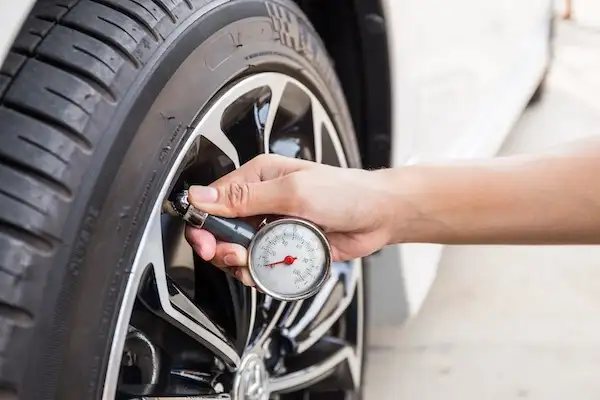
Use a quality digital tire pressure gauge ($15-25 at any auto parts store) rather than gas station gauges, which are often inaccurate from abuse and poor calibration. The accuracy of your pressure monitoring directly affects tire wear, fuel economy, and safety.
The correct tire pressure is listed on a sticker inside the driver’s door jamb, NOT on the tire sidewall. The sidewall shows maximum pressure the tire can handle, not the optimal pressure for your specific VW model. Typical VW pressures range from 32-38 PSI depending on model and tire size.
Under-inflation is the most common tire pressure mistake and causes multiple problems:
Accelerated shoulder wear: The tire’s outer edges contact the pavement more than the center, creating rapid wear on both shoulders. This pattern is unmistakable—outside edges worn significantly more than center tread.
Heat buildup: Under-inflated tires flex more during rotation, generating excessive heat that accelerates rubber degradation and increases blowout risk. In Southern California heat, this effect compounds dramatically.
Reduced fuel economy: Under-inflation increases rolling resistance, forcing your engine to work harder. Just 5 PSI below specification reduces fuel economy by 1-2 MPG. Over a year, that’s $120-180 in wasted fuel.
Handling degradation: Under-inflated tires respond sluggishly to steering inputs and reduce cornering grip, affecting safety.
Over-inflation causes different issues:
Center wear: The tire’s center contacts the pavement more than the edges, creating wear down the middle of the tread while edges remain relatively new.
Harsh ride: Over-inflated tires transmit more road impacts to the suspension and cabin, creating uncomfortable ride quality.
Reduced grip: The smaller contact patch from over-inflation decreases traction, particularly in wet conditions.
Impact damage susceptibility: Over-inflated tires have less cushion to absorb pothole impacts, increasing risk of wheel or tire damage.
“Tire pressure is the most neglected maintenance item we see,” says David Martinez, Service Manager at the Camino Real location. “Customers come in with wear patterns clearly showing chronic under-inflation or over-inflation—patterns that developed over 15,000-20,000 miles of driving with incorrect pressure. We check and adjust pressure at every service visit, but tires need pressure checks monthly between services. In Southern California’s temperature extremes, pressure can vary by 6-8 PSI between winter mornings and summer afternoons. Monthly checking is essential, not optional.”
Nitrogen inflation is marketed as superior to air for maintaining consistent pressure. While nitrogen does hold pressure more consistently through temperature changes, the difference is modest—perhaps 1-2 PSI better than air over months. For most drivers, regular pressure checks with normal air are adequate and free at most gas stations. Nitrogen costs $30-50 per fill and doesn’t eliminate the need for monthly pressure checks.
The spare tire often gets forgotten in pressure checks. Verify your spare is properly inflated quarterly. A flat spare helps nobody during roadside emergencies.
Tire Rotation: Distributing Wear for Maximum Life
Regular tire rotation is the most cost-effective tire maintenance, extending tire life by 20-30% through even wear distribution.
VW recommends tire rotation every 10,000 miles for most models. However, Southern California’s demanding conditions justify 7,500-mile intervals for many drivers. The cost difference is minimal—perhaps one additional rotation every 30,000 miles—but the protection for your tire investment is substantial.
All-wheel-drive VWs (Tiguan, Atlas, Taos AWD, etc.) particularly benefit from frequent rotation. AWD systems distribute power to all four wheels constantly, creating more even wear than front-drive vehicles but also making rotation critical for maintaining proper AWD operation. Tire diameter differences from uneven wear confuse AWD sensors and can damage drivetrain components.
Rotation patterns vary based on drivetrain and tire type:
Front-wheel-drive (Jetta, Passat, Golf): Front tires move straight back, rear tires cross to front positions (rear left to front right, rear right to front left).
All-wheel-drive: Front tires move straight back, rear tires move straight forward (simpler pattern maintaining directional orientation).
Directional tires: Front and rear swap on each side without crossing (left front to left rear, left rear to left front, same on right side).
Professional rotation service costs $35-55 and takes 30 minutes. This service should include:
- Proper rotation pattern for your drivetrain
- Tire pressure check and adjustment on all four tires plus spare
- Visual inspection for damage, uneven wear, or embedded objects
- Tread depth measurement at multiple points on each tire
- Wheel hardware inspection and proper torque
Skipping rotations creates uneven wear requiring premature tire replacement:
A customer from Fontana skipped tire rotations on his Tiguan for 28,000 miles. His front tires wore to 3/32 inch while rears measured 7/32 inch. Because AWD vehicles need all tires matching within 2/32 inch tread depth, he had to replace all four tires despite the rears having significant remaining life. His neglect wasted approximately $400 in usable rear tire life.
Rotation also provides opportunities to catch developing problems:
- Uneven wear patterns indicating alignment or suspension issues
- Punctures or cuts requiring repair before they fail
- Wheel damage from pothole strikes or curb contact
- Valve stem deterioration before air loss occurs
Many VW service facilities include tire rotation with oil changes at no additional charge. Take advantage of this service—it’s essentially free tire life extension and problem detection.
Tread Depth: Knowing When to Replace
Understanding tread depth and knowing when tires need replacement prevents the dangerous situations that worn tires create.
New tires typically have 10/32 to 11/32 inch tread depth. As tires wear, this depth decreases. Legal minimum tread depth in California is 2/32 inch, but safety requires replacement well before reaching legal minimums.
Replace tires at 4/32 inch for maximum safety in varied conditions. At this depth, wet weather traction begins degrading significantly. Southern California’s occasional winter rains create hazardous conditions on roads coated with months of accumulated oil and debris. Adequate tread depth is essential for channeling water and maintaining grip.
Measuring tread depth requires a tread depth gauge ($8-12) or the penny test: Insert a penny into the tread groove with Lincoln’s head upside down. If you can see the top of Lincoln’s head, tread depth is 2/32 inch or less—replace immediately. If Lincoln’s head is partially covered, measure accurately with a gauge to determine remaining life.
Measure tread depth at multiple points across each tire and on all four tires. Uneven wear between tires or across a single tire indicates problems requiring attention:
Inside or outside edge wear: Alignment problems or incorrect pressure Center wear: Chronic over-inflation
Both edge wear: Chronic under-inflation Patchy wear: Suspension component wear or wheel balance problems Feathering (saw-tooth patterns): Alignment toe issues
These patterns indicate underlying problems requiring correction to prevent premature wear on replacement tires. Fixing alignment before installing new tires ensures they wear evenly from the start.
Tire age matters as much as tread depth. Tires degrade chemically over time regardless of mileage. The tire industry recommends replacement at 10 years regardless of tread depth, but Southern California’s UV exposure and heat justify replacement at 6-8 years even with adequate tread remaining.
Check tire age using the DOT code on the sidewall. The last four digits show week and year of manufacture—”2318″ means 23rd week of 2018. Tires manufactured in 2018 should be replaced by 2024-2026 in Southern California conditions regardless of tread depth.
Visible cracking in tread grooves or sidewalls indicates age-related deterioration requiring immediate replacement. Don’t gamble with aged tires showing cracking—structural failure can happen without warning.
Tread depth affects hydroplaning resistance dramatically. Hydroplaning occurs when tires can’t channel water fast enough, losing contact with pavement. Deeper treads channel water more effectively. While Southern California sees limited rain, the occasional winter storms create dangerous conditions on freeways and surface streets when months of oil buildup combines with water.
At 4/32 inch, hydroplaning risk increases significantly at highway speeds. At 2/32 inch, hydroplaning can occur at 35-40 MPH—dangerous speeds for normal driving. Don’t wait until tires are dangerously worn—replace at 4/32 inch for safety.
A customer from San Bernardino experienced hydroplaning during a rare January rainstorm on the I-10, spinning across multiple lanes before regaining control. His tires measured 3/32 inch tread depth—barely legal but inadequate for wet conditions. The terrifying experience convinced him to replace tires earlier in their life cycle. “I almost died to save $200 by running tires another 5,000 miles,” he said. “New tires are expensive, but they’re cheaper than hospital bills or a funeral.”
Wheel Alignment: Protecting Your Tire Investment
Proper wheel alignment is essential for even tire wear and safe handling.
Alignment angles determine how your tires contact the road and relate to each other. Even small deviations from VW specifications cause rapid, uneven tire wear that destroys tires prematurely.
Southern California roads create alignment challenges through:
Potholes: Winter rain damage creates potholes on surface streets and freeway shoulders. A single significant pothole strike can knock alignment out of specification immediately.
Rough pavement: Broken asphalt on older roads subjects suspension to constant impacts that gradually shift alignment over time.
Curb strikes: Tight parking situations, misjudged clearances, or inattention cause wheel-to-curb contact that bends suspension components or shifts alignment.
Speed bumps and dips: Aggressive approach to parking lot speed bumps or drainage dips impacts suspension asymmetrically, contributing to alignment drift.
Alignment should be checked:
- Every 12-15,000 miles as preventive maintenance
- After any pothole strike or curb impact
- When installing new tires
- When symptoms appear (pull, drift, uneven wear, off-center steering wheel)
- After suspension or steering repairs
Four-wheel alignment service costs $145-195 and includes measuring and adjusting all wheel angles to VW specifications. This service protects your $800-1,200 tire investment from the premature wear that misalignment causes.
The cost-benefit equation strongly favors regular alignment:
Without regular alignment: Tires might last 25,000 miles before uneven wear requires replacement. Over 100,000 miles, you’ll need four tire sets at $1,000 each = $4,000.
With alignment every 15,000 miles: Tires last 50,000 miles with even wear. Over 100,000 miles, you’ll need two tire sets at $1,000 each = $2,000, plus seven alignments at $165 each = $1,155. Total: $3,155.
Savings from proper alignment: $845 over 100,000 miles, plus better handling and safety throughout.
A customer from Rialto noticed his Jetta pulling slightly right for several months but dismissed it as “normal.” When he finally brought it in at 38,000 miles, his right front tire showed severe inside edge wear requiring immediate replacement. Alignment revealed 1.2 degrees of toe-out on that wheel. The pull he’d ignored cost him premature tire replacement ($280), and alignment service to prevent the problem from continuing ($165). Total: $445. An alignment check when the pull first appeared would have cost $165 and prevented the tire damage entirely. His procrastination cost $280.
Highway Driving Considerations
Extended freeway commuting creates specific tire care requirements different from pure city driving.
Sustained high speeds generate heat through tire flexing and friction. Highway speeds of 70-80 MPH create substantially more heat than 35 MPH city driving. This heat accelerates rubber compound degradation and increases blowout risk if tire condition is marginal.
Before long highway drives, verify tire pressure is correct when cold. Under-inflation at highway speeds compounds heat buildup dramatically, creating dangerous conditions. Many tire blowouts on freeways trace to driving on under-inflated tires that overheated.
Highway debris presents hazards that city streets don’t. Truck tire remnants, construction materials, and cargo spills litter freeway lanes. These objects can puncture tires or cause impact damage requiring replacement.
After highway drives involving debris strikes or significant impacts, inspect tires for:
- Bulges or bubbles in sidewalls indicating internal damage
- Cuts or punctures in tread or sidewalls
- Embedded objects (nails, screws, metal fragments)
- Unusual vibrations that developed during the drive
Highway wear patterns differ from city driving. Sustained speeds at consistent loads create relatively even wear across the tread surface. This is beneficial—even wear maximizes tire life. However, high annual mileage from extensive highway driving means tires reach their wear limits faster in calendar time.
Plan for tire replacement based on both mileage and time. A highway commuter driving 25,000 miles annually might need tires every 2-3 years, versus 4-5 years for someone driving 12,000 miles annually.
Balancing becomes more critical for highway driving. Unbalanced wheels create vibrations that are barely noticeable at city speeds but become significant at 70-80 MPH. These vibrations accelerate suspension wear and create driver fatigue.
Have wheels balanced when installing new tires, and rebalanced if vibration develops. Balance service costs $60-80 for all four wheels and should resolve highway vibration issues. If vibration persists after balancing, tire defects or wheel damage may exist requiring further diagnosis.
City Driving and Stop-and-Go Traffic
Urban driving in San Bernardino, Riverside, and surrounding areas creates tire stress different from highway commuting.
Frequent acceleration and braking from stop-and-go traffic generates heat through tire flexing. Each stop scrubs rubber from the tread through friction. While individual stops are minor, thousands of stops over a tire’s life accumulate to significant wear.
Front tires on front-wheel-drive VWs experience accelerated wear from city driving because they handle acceleration forces, most braking forces, and all steering forces simultaneously. This explains why front tires wear faster than rears and why rotation is critical for front-drive vehicles.
Low-speed impacts from potholes, speed bumps, and rough pavement affect tires differently than highway driving. City streets often have poorer pavement conditions than freeways, subjecting tires to constant small impacts that highway driving avoids.
These impacts can cause:
- Sidewall damage from hitting potholes at angles
- Tread separation from repeated flexing over rough surfaces
- Valve stem damage from extreme wheel flex
- Wheel damage that leads to air leaks or balance problems
Parking challenges in urban areas create tire risks. Curbs, parking blocks, and tight spaces lead to curb strikes that damage sidewalls or knock alignment out of specification. Parallel parking on steep grades can stress sidewalls as the full vehicle weight rests on one or two tires at extreme angles.
After curb contact, inspect the affected tire’s sidewall carefully for cuts, bulges, or abrasions. Sidewall damage compromises tire structure and often requires replacement even if the damage seems minor. Sidewalls are thinner than tread areas and less able to withstand damage.
Heat absorption from hot pavement affects tires during summer parking. Asphalt at 165 degrees transfers heat into stationary tires, cooking them from the outside. Extended parking in direct sun compounds this effect. Park in shade when possible to reduce tire heat exposure.
Seasonal Considerations for Southern California
While Southern California doesn’t experience traditional seasons, tire care requirements change throughout the year.
Summer (June-September): Peak heat creates maximum tire stress. Pavement temperatures exceed 160 degrees regularly. Tire pressure increases 3-5 PSI from morning to afternoon due to heat.
Summer tire care priorities:
- Check pressure weekly during heat waves
- Park in shade when possible
- Avoid overloading vehicle (reduces heat capacity)
- Inspect for heat-related damage (cracking, bulging)
- Consider replacing aged tires before summer rather than gambling through peak heat
Winter (December-February): Cooler temperatures cause tire pressure to drop. Morning temperatures in the 40s mean tires lose 3-4 PSI overnight. Occasional rain creates hazardous conditions on oil-slicked roads.
Winter tire care priorities:
- Verify adequate tread depth before rainy season (minimum 4/32 inch)
- Check pressure weekly as temperatures fluctuate
- Inspect tread for even wear and adequate depth for wet traction
- Clean tires and wheels to remove brake dust that holds moisture
Transition seasons: Spring and fall bring temperature swings requiring attention. Morning pressure at 60 degrees increases to afternoon pressure at 90 degrees, creating 4-5 PSI variation requiring monitoring.
Mountain driving: Trips to Big Bear, Lake Arrowhead, or Wrightwood introduce additional considerations. Elevation changes, steep grades, and switchback curves stress tires differently than valley driving. Verify tire condition and pressure before mountain trips. The descent is particularly demanding on tires and brakes—overheated brakes can damage tires through radiant heat.
Tire Selection and Replacement
Choosing proper replacement tires ensures your VW maintains designed performance, efficiency, and safety.
Tire size must match what’s specified on your door jamb sticker and what VW engineered for your specific model. Using different sizes affects speedometer accuracy, AWD system operation, handling characteristics, and fuel economy.
Tire ratings matter:
Speed rating: Must meet or exceed your VW’s capability. Most modern VWs require H (130 MPH) or V (149 MPH) rated tires. Using lower speed ratings compromises safety and handling.
Load rating: Must handle your vehicle’s weight plus cargo and passengers. Never use tires with lower load ratings than specified—they can fail catastrophically from overloading.
Treadwear rating: Higher numbers indicate longer expected life, but harder compounds may sacrifice grip. Ratings of 500-600 provide good balance for most drivers.
Traction ratings: AA or A provide best wet traction, critical for Southern California’s occasional rain.
Temperature ratings: A-rated tires handle heat best—important for our climate.
Quality tiers:
Premium brands (Michelin, Continental, Bridgestone, Goodyear): $160-280 per tire. Best performance, longest life, superior wet traction. Worth the premium for safety and total cost of ownership.
Mid-tier brands (General, Hankook, Kumho, Yokohama): $120-180 per tire. Good quality with longer wear than economy brands. Reasonable compromise for budget-conscious buyers.
Economy brands (various): $80-120 per tire. Minimal safety standards but inferior wet traction, shorter life, and potential performance issues. False economy—savings evaporate through premature replacement and compromised safety.
For Southern California conditions, premium tires justify their cost through superior heat resistance, UV protection, and wet traction. The $200 premium for four premium tires over mid-tier options pays back through extended life and safety.
All-season vs. summer tires: All-season tires provide year-round capability appropriate for our climate. Summer performance tires offer maximum dry grip but become unsafe below 40 degrees (rare but possible in winter mornings). Unless you’re willing to swap tires seasonally, all-season tires are the practical choice.
Replace all four tires simultaneously on AWD vehicles. The AWD system requires all tires to match in diameter within 2/32 inch tread depth. Replacing only two tires creates diameter mismatches that confuse AWD sensors and accelerate drivetrain wear.
Your 30-Day Tire Care Action Plan
Taking control of your tire maintenance starts with three simple actions you can complete this month.
This week: Perform comprehensive tire inspection on all four tires plus spare. Check tire pressure when cold using a quality gauge—adjust to door jamb specifications. Measure tread depth at multiple points on each tire using a tread depth gauge. Inspect sidewalls for cracking, bulges, cuts, or embedded objects. Look for uneven wear patterns indicating alignment or pressure issues. Document current condition with photos and measurements for future comparison. If you find problems (low pressure, low tread, damage, uneven wear), schedule service immediately.
Within two weeks: Review your tire service history and create a maintenance schedule. When was your last tire rotation? If it’s been over 10,000 miles, schedule rotation now. When were tires last balanced? If you’ve developed vibration, schedule balancing. When was your last alignment check? If it’s been over 15,000 miles or you’ve hit significant potholes, schedule alignment verification. Create calendar reminders for monthly pressure checks and schedule your next rotation at 7,500-mile intervals.
By month’s end: Calculate tire replacement timing based on current tread depth and your annual mileage. If tires measure 5/32-6/32 inch and you drive 20,000 miles annually, you’ll need replacement in 6-8 months. Start budgeting $800-1,200 for new tires and research tire options appropriate for your VW and driving patterns. Understanding when tires need replacement prevents surprise expenses and unsafe driving on worn tires. For tires over 6 years old regardless of tread depth, schedule replacement before summer heat.
These three steps take approximately 90 minutes but provide complete understanding of your tires’ condition and establish proper monitoring habits protecting your investment.
The Real Cost of Tire Neglect
Understanding the full financial and safety impact of tire neglect helps justify proper maintenance investment.
Premature tire replacement from neglected pressure, rotation, or alignment:
- Proper care: 50,000 miles per set = $1,000 per 50,000 miles
- Neglect: 25,000 miles per set = $2,000 per 50,000 miles
- Excess cost: $1,000 per 50,000 miles
Reduced fuel economy from under-inflation:
- 5 PSI low reduces fuel economy 1.5 MPG average
- At 20,000 annual miles and $4.50/gallon: $225 annually wasted
- Over five years: $1,125 wasted fuel
Blowouts and roadside emergencies:
- Tow truck: $125-200
- Tire replacement: $200-280
- Lost time and stress: immeasurable
- Potential collision damage: thousands
- Insurance rate increases: hundreds annually for years
Reduced safety from worn or damaged tires increases accident risk. Inadequate tread in rain, age-compromised structure, or damage from neglected maintenance all create dangerous situations where tires cannot perform their critical safety function.
Total cost of tire neglect over 100,000 miles: $2,000-3,000+ in unnecessary expenses beyond the stress and safety risks that money can’t quantify.
Total cost of proper tire maintenance over 100,000 miles: $400-600 in preventive service (rotations, alignments, pressure monitoring) protecting $2,000-2,400 in tire investments.
The math isn’t close—proper tire maintenance saves money while providing safety and peace of mind. Neglect costs more in every measurable way.
Need expert tire service from technicians who understand Southern California’s demanding conditions? Our service department offers comprehensive tire care including rotation, alignment, balancing, and replacement with quality brands.
Schedule Your Tire Service Today
Your Volkswagen’s tires are the only components touching the road—they’re critical for acceleration, braking, handling, and safety. In Southern California’s extreme heat, extensive highway driving, and varied urban conditions, proper tire care isn’t optional maintenance, it’s essential protection.
Our certified VW technicians at the Camino Real location understand the unique demands Southern California places on tires. We use precision equipment for alignment, computerized balancing, and careful inspection, ensuring your tires deliver maximum life, safety, and performance.
Schedule your tire service today by calling our service department or booking online. Visit us at 1600 Camino Real, San Bernardino, CA 92408, conveniently located with easy access from the I-10, I-215, and throughout the Inland Empire.
Proper tire care protects your investment, ensures safety through all driving conditions, and delivers the performance and efficiency your Volkswagen was designed to provide. That’s the confidence expert tire service delivers.
0 comment(s) so far on Tire Care Tips for Highway & City Driving in Southern California