




Inland Empire Dust Defense: Protecting Your VW Cabin & Engine Air Systems Near Cajon Wash
Key Takeaways
- Cajon Wash’s dry, sandy terrain generates fine airborne particulate year-round: Wind events and disturbed soil near the wash push more dust into circulation than typical urban driving conditions.
- Cabin and engine air filters clog faster in high-dust environments: What’s a standard mileage interval elsewhere doesn’t hold up the same way in the Inland Empire’s dust exposure.
- A clogged cabin filter affects more than smell: Reduced airflow can strain HVAC blower motors and reduce defrost effectiveness when it matters most.
- Engine air filter restriction affects performance and efficiency: Airflow reduction from a dust-loaded filter can measurably impact both power delivery and fuel economy.
San Bernardino drivers whose routes take them near Cajon Wash, along the I-15 corridor, or through the sandier stretches around Devore and the Cajon Pass approach, are driving through more airborne dust exposure on a regular basis than most Volkswagen owners account for in their maintenance planning.
Why This Area Is a Uniquely Dusty Environment
Cajon Wash and the surrounding terrain sit in a natural wind corridor, where seasonal Santa Ana conditions and general Inland Empire wind patterns pick up fine, dry particulate from exposed sandy and disturbed soil areas. Unlike the coarser dust and debris found in more developed urban environments, the material here tends to be finer and more easily airborne, meaning it stays suspended longer and infiltrates a vehicle’s air intake systems more readily.
This isn’t limited to days with visibly poor air quality or dust storm conditions. Even on a calm, clear day, background particulate levels near the wash and along nearby unpaved shoulders and access roads tend to run higher than in surrounding coastal or more vegetated areas, which means the exposure is closer to constant than occasional for regular commuters through the area.
How Dust Affects Your Cabin Air Filter
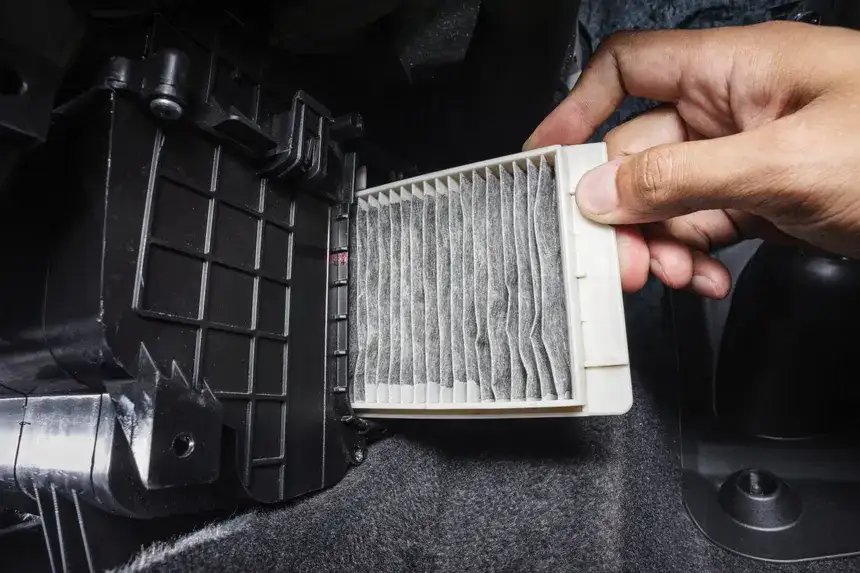
The cabin air filter is the first line of defense between outside air and the air circulating through your Volkswagen’s interior. In a normal driving environment, this filter is designed to last through a standard service interval while managing typical road dust, pollen, and airborne debris. In a high-dust environment like the Cajon Wash corridor, that same filter loads up with particulate considerably faster.
A dust-clogged cabin filter doesn’t just mean a musty smell or reduced fresh air feel. As restriction increases, the HVAC blower motor has to work harder to push air through the clogged media, which can shorten blower motor life over time and, in more severe cases, reduce the volume of air available for defrosting the windshield when it’s needed most. Reduced airflow can also mean the air conditioning system takes longer to reach a comfortable cabin temperature, since the compressor and evaporator are only as effective as the air volume moving across them.
How Dust Affects Your Engine Air Filter
The engine air filter faces a similar challenge, but with different stakes. This filter protects the engine’s intake system from abrasive particulate that could otherwise cause premature wear on cylinder walls and internal components. In a high-dust environment, the filter media loads with fine particulate faster than the standard interval assumes, and as it does, airflow into the engine becomes progressively more restricted.
- Reduced airflow can cause the engine management system to compensate in ways that affect fuel efficiency, since the engine isn’t receiving air in the volume and pattern it’s calibrated around
- Power delivery can feel slightly diminished under acceleration as the engine works to draw air through an increasingly restricted filter
- In more extreme cases of prolonged neglect, a severely clogged filter can allow fine dust to bypass filter media at points where the seal has degraded, introducing abrasive particulate directly into the intake
None of these effects tend to be sudden or dramatic. They build gradually, which is part of why a filter that’s significantly more loaded than its mileage would suggest can go unnoticed until a service visit reveals it.
Signs Your Air Systems May Need Attention
- A musty or stale smell from the vents, particularly when the AC or heat first kicks on
- Noticeably reduced airflow from the cabin vents even at higher fan settings
- A rough idle or slightly hesitant acceleration that wasn’t there before
- Visible dust accumulation around the glovebox area, where the cabin filter housing is typically located
Adjusting Your Maintenance Schedule for This Environment
Because manufacturer-recommended filter intervals are generally calibrated around average driving conditions, they don’t fully account for a dust environment like the one around Cajon Wash. Drivers who regularly travel through this corridor, whether commuting via the I-15 or accessing areas near Devore and the Cajon Pass, benefit from having both cabin and engine air filters checked more frequently than the standard interval suggests, since visual inspection often reveals a filter that’s more heavily loaded than its mileage alone would indicate.
If your regular driving takes you through the Cajon Wash area or the surrounding dust-prone stretches of the Inland Empire, it’s worth having your cabin and engine air filtration checked on a schedule that reflects that exposure. Volkswagen San Bernardino, located at 1600 Camino Real, San Bernardino, CA 92408, offers air filter inspections for both cabin and engine systems, helping catch dust-related restriction before it affects comfort, performance, or long-term engine health.
0 comment(s) so far on Inland Empire Dust Defense: Protecting Your VW Cabin & Engine Air Systems Near Cajon Wash