




Desert Dust & Cabin Filters: Protecting your engine and lungs from San Bernardino’s air quality
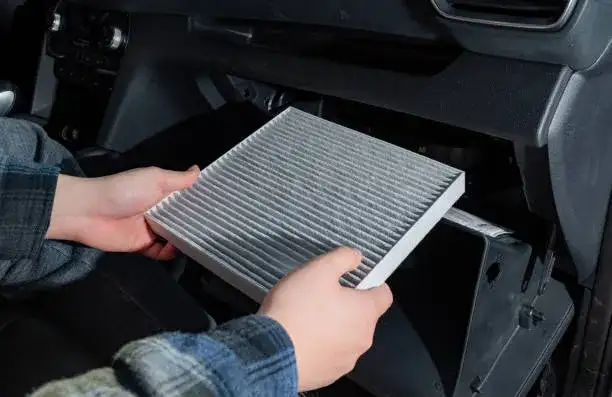
Elena had been dealing with allergy-like symptoms during her morning commute on the 215 for most of the spring. She assumed it was seasonal pollen and managed it with over-the-counter medication for two months. When she finally brought her Volkswagen Tiguan in for a routine oil change, we pulled her cabin air filter and found it completely saturated with the fine particulate matter typical of San Bernardino’s air quality during high-wind periods. Replacing the cabin filter and performing an engine air filter service cost $145. The two months of allergy medication she had purchased trying to manage symptoms caused by her own car’s filtration system added up to more than that.
San Bernardino sits at the eastern end of the Los Angeles Basin in a geography that concentrates air quality problems in ways that most California cities don’t experience. The mountains to the north and east trap pollutants that blow in from the coast and the urban corridor, the dry desert floor to the east contributes fine silica particulate whenever the wind picks up through the Cajon Pass, and the I-215 and I-10 freeway corridors running through the city carry some of the highest diesel truck traffic volumes in the western United States. For Volkswagen owners who commute on Camino Real, run errands near Hospitality Lane, or spend meaningful time on the 215 between San Bernardino and Murrieta, the air their vehicle is filtering is among the most challenging in California.
The consequence of that air quality shows up in two places: the engine air filter that protects the intake system and directly affects performance and fuel economy, and the cabin air filter that determines the quality of air you and your passengers breathe during every minute spent inside the vehicle. At Volkswagen San Bernardino, we inspect both filters on every service visit, and what we find consistently is that San Bernardino’s air quality shortens the effective service life of both filters well below the intervals that VW’s standard maintenance schedule assumes. Understanding why matters for both your vehicle’s health and your own.
What Each Filter Actually Does and Why Both Matter
The engine air filter sits between the outside air and the intake manifold and prevents particulate matter from entering the combustion chamber with the incoming air charge. Its job is mechanical protection of precision components. A clogged or degraded engine filter restricts airflow, forces the engine to work harder for the same output, reduces fuel economy measurably, and in severe cases allows fine particulate to reach the intake valves and combustion chamber surfaces where it accelerates wear and deposit formation. In the 2.0T TSI engines common across the Volkswagen lineup, intake valve deposits from degraded filtration are a known long-term consequence of operating in high-particulate environments without appropriate filter management.
The cabin air filter serves a completely different function. It sits in the HVAC system and filters the air that enters the passenger compartment through the ventilation, heating, and air conditioning systems. A functioning cabin filter removes pollen, dust, fine particulate, diesel exhaust particles, and in many cases bacteria and mold spores from the air before it reaches the occupants. A clogged cabin filter does the opposite of its job, it restricts airflow through the HVAC system, reduces AC and heating efficiency, and in some cases allows the accumulated particulate on its surface to become a secondary contamination source as air forces through the saturated material.
What San Bernardino’s Air Actually Contains 🌫️
Understanding what the filters in your Volkswagen are working against helps explain why service intervals calibrated for average California conditions don’t apply in the Inland Empire. San Bernardino’s air quality challenge comes from several distinct sources that combine into a uniquely demanding filtration environment.
Desert particulate from the Mojave floor east of the city is fine-grained silica and mineral dust that the Santa Ana winds push through the Cajon Pass and across the San Bernardino Valley multiple times each year. This material is finer than typical road dust and penetrates filter media more aggressively than the coarser particles that filters in coastal or inland valley locations deal with. Diesel exhaust particulate from the freight corridor along the I-10 and I-215 adds a layer of carbon-based fine particulate that accumulates on filter surfaces differently than mineral dust and can carry chemical compounds that a standard filter captures but doesn’t neutralize.
Agricultural and construction dust from the active development corridors between San Bernardino and the Riverside County line contributes a variable load that peaks during dry, windy periods and drops during the brief winter rain season. The result is a filter environment that is never light and is frequently extreme, particularly during Santa Ana events when particulate loads in the Inland Empire can reach levels that the South Coast AQMD classifies as unhealthy for sensitive groups.
What Proper Filter Maintenance Costs vs. What Neglect Costs 💰
Keeping both filters current in San Bernardino’s air environment is genuinely inexpensive relative to the consequences of deferring them:
- Cabin air filter replacement: $55 to $95 depending on filter type and model
- Engine air filter replacement: $45 to $75
- Both filters replaced together: $90 to $150 at a single visit
- HVAC evaporator cleaning (from clogged cabin filter allowing mold growth): $185 to $280
- Intake valve cleaning service (from degraded engine filtration): $280 to $480
- Fuel system cleaning (from combustion deposits related to poor filtration): $95 to $150
A driver who replaces both filters every 12,000 miles in San Bernardino’s environment spends roughly $180 to $300 over two years. A driver who defers both until symptoms appear, reduced AC output, declining fuel economy, or health symptoms during commutes, often faces $500 to $900 in corrective services on top of the filter replacements that were always going to be needed anyway.
A Commuter Who Connected the Dots
A Volkswagen Jetta owner from Rialto came in last summer after his air conditioning had been noticeably weaker than the previous year despite the system otherwise functioning normally. He ran the AC continuously on his daily commute on the 215 toward Ontario and had attributed the reduced output to the system aging. When we inspected the cabin filter, it had compacted to the point where airflow through the HVAC system was measurably restricted. The filter had been in the vehicle for 26,000 miles and two full Santa Ana seasons. Replacing it restored his AC output immediately and completely for $75. He had been running his blower on a higher fan setting for months to compensate for the restriction, which was consuming more energy and placing additional load on the blower motor without addressing the actual cause.
Warning Signs Both Filters Need Attention ⚠️
San Bernardino’s air quality makes filter degradation faster and less predictable than the standard mileage intervals suggest. These are the indicators to watch for:
Reduced airflow from the cabin vents despite normal fan settings: A cabin filter that is approaching saturation restricts airflow through the HVAC system before it fails completely. If you notice the air from your vents feels weaker on the 215 commute than it did six months ago, the cabin filter is the first thing to check.
AC that takes longer to cool the cabin than it used to: Restricted airflow from a clogged cabin filter reduces the volume of air moving across the evaporator, which directly reduces cooling capacity. The system is not failing. It is being starved of the airflow it needs to do its job.
Musty or dusty smell from the vents when the HVAC first starts: A cabin filter that has accumulated significant particulate can produce an odor when air forces through the saturated material. In San Bernardino’s environment this smell often has a distinctly mineral or dusty quality rather than the mold-associated musty smell more common in humid climates.
Fuel economy that has declined without changes in driving habits: A restricted engine air filter forces the engine to work harder for the same air volume, which increases fuel consumption measurably. On the consistent commute routes along the 215 and 10, a fuel economy drop of 1 to 2 mpg without any other explanation points directly to engine air filter condition.
Engine that feels slightly less responsive at highway on-ramps: Reduced intake airflow from a clogged engine filter affects throttle response at higher demand points, like the acceleration required merging onto the 215 from Baseline Street. The difference is subtle at first but becomes more noticeable as restriction increases.
Allergy or respiratory symptoms that are worse during commutes: If symptoms that feel like allergies or irritation are more pronounced inside your vehicle than outside it, the cabin filter may be the source rather than the outside air. A saturated filter in San Bernardino’s particulate environment can re-introduce captured material into the airflow when the blower is running at higher speeds.
Check engine light related to airflow or mass air flow sensor: A severely restricted engine air filter can produce lean condition codes or mass airflow sensor readings that trigger a check engine light. At this stage the filter has been past its service window for a significant period and intake system inspection is warranted alongside the replacement.
What Our Service Team Says
“San Bernardino is genuinely one of the harder environments for filtration I’ve seen in this region. We pull cabin filters here that look like they’ve been in the vehicle twice as long as they actually have. The standard replacement interval that VW publishes assumes average air quality, and the Inland Empire during Santa Ana season is not average by any measure. My rule of thumb for customers in this area is 12,000 miles or once a year, whichever comes first, and if you’ve been through a significant wind event, have us check the cabin filter at your next visit regardless of mileage.” — Miguel Reyes, Senior Service Technician, Volkswagen San Bernardino
When Replacing Both Filters Changed Everything
Rosa drives her Volkswagen Atlas between San Bernardino and her workplace near the Ontario Mills area on the 10 freeway five days a week. She came in for her annual service and mentioned in passing that her allergies had been particularly bad during her commute all spring. When we pulled both filters, the cabin filter was visibly gray and compacted and the engine filter showed significant particulate loading. Both were replaced for $135 total. She called us two days later to say her commute symptoms had cleared entirely and her AC was blowing noticeably stronger than it had been. She had been attributing symptoms to seasonal allergies for months when the actual source was sitting in her dashboard.
Your 30-Day Filter Health Check
This week, pay attention to two specific things during your next few commutes on the 215 or the 10. Note whether your cabin airflow feels as strong as it did when the vehicle was newer, particularly on the higher fan settings you use when the AC is working against San Bernardino’s summer heat. Also note whether there is any smell from the vents on startup, particularly after the vehicle has been parked outside during a windy period. Those two observations take zero additional time and give you useful baseline information for your next service visit.
Within two weeks, check your service records for the last date both filters were replaced and calculate the mileage since then. If either filter is past 12,000 miles or more than 12 months old in San Bernardino’s environment, replacement is appropriate regardless of whether dramatic symptoms have appeared. Filter degradation in this air quality environment rarely announces itself dramatically before it has already been affecting performance and air quality for some time.
By month’s end, schedule a filter inspection and replacement service at Volkswagen San Bernardino if either filter is due or approaching its interval. Ask our team to check both filters together at a single visit to consolidate the service and reduce your time in the shop. We can also inspect the HVAC evaporator housing for any particulate accumulation that a long-running clogged cabin filter may have allowed past the filter media. These steps take less than an hour total and address the two filtration points that most directly affect both your vehicle’s performance and the quality of air inside your Volkswagen every single day you drive it.
Schedule Your Filter Service at Volkswagen San Bernardino
Elena, whose allergy symptoms cleared after a $145 filter service she had been putting off for months, now comes in every 12,000 miles for both filter replacements as a standing item on her service schedule. She told us afterward that she had never connected her commute symptoms to her car’s filtration system and wished someone had explained it sooner. The air inside your Volkswagen is only as clean as the filters keeping it that way, and in San Bernardino’s environment those filters are working harder than almost anywhere else in California.
Visit us at Volkswagen San Bernardino, located at 1600 Camino Real, San Bernardino, CA 92408. Our service department is open Monday through Saturday. Schedule your filter service online through our website or speak with one of our service advisors directly. We serve drivers throughout San Bernardino, Rialto, Fontana, Colton, Ontario, and across the Inland Empire. San Bernardino’s air quality is not getting easier on your filters. Make sure yours are ready for it. 🌬️
0 comment(s) so far on Desert Dust & Cabin Filters: Protecting your engine and lungs from San Bernardino’s air quality